
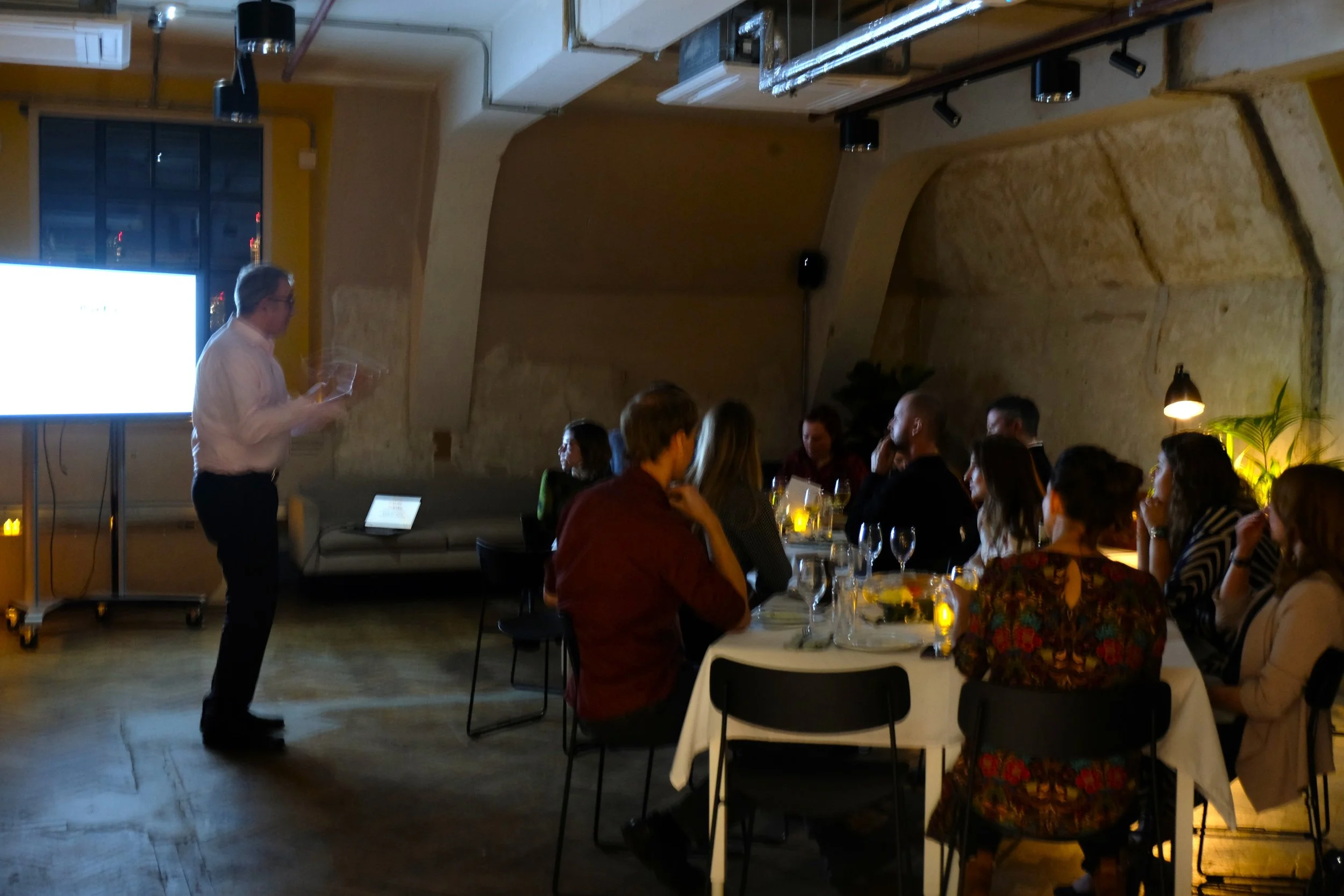
Richard presenting AirEx Floorvent data
Last week we hosted our first AirEx Round Table Dinner, bringing together housing providers, contractors and retrofit professionals to talk openly about ventilation, retrofit and what “good” looks like in practice.
The aim was not to present solutions or promote particular approaches, but simply to listen. Too often in our sector we talk about delivery in theory. We reference policy, standards and funding programmes, but we do not always spend enough time discussing the practical realities of delivering healthier homes day to day. Creating space for that kind of honest conversation felt important.
The vibe around dinner was excellent and the discussion was open, thoughtful and at times refreshingly candid. What emerged from the room was not disagreement about where the sector needs to get to. There was broad agreement on the destination: warm, healthy, energy efficient homes that work well for the people living in them. The challenge, as several participants observed, is less about ambition and more about alignment. The systems we use to deliver improvements to homes are not always working together as effectively as they might.
One area where that tension is particularly visible is the growing focus on damp and mould. The introduction of Awaab’s Law has fundamentally changed expectations. What was often treated historically as a maintenance issue is now clearly recognised as a serious building health and resident wellbeing issue, with regulatory and governance implications. That shift is both necessary and welcome. However, while expectations have changed quickly, delivery systems are still catching up. Interpretation of requirements varies across organisations and, in many places, responses to damp and mould are still handled case by case rather than embedded within a broader asset management and retrofit strategy.
This becomes especially challenging when issues emerge during retrofit programmes. We Heard about situations where a serious mould problem appeared in a home that was already part of a planned improvement scheme. The immediate response understandably focuses on addressing the resident’s situation, but the intervention can disrupt the original design assumptions, the sequencing of works and sometimes the funding model behind the project. These moments reveal something important. Reactive repairs and planned retrofit programmes are still often operating alongside each other rather than as part of a single, integrated system.
Ventilation was the key theme throughout the evening, but in many retrofit programmes it still tends to enter the conversation once problems appear rather than forming part of the original design thinking. By the time ventilation measures are introduced they can sit outside the planned scope of work, which slows delivery and complicates decision making. More fundamentally, it highlights a broader challenge in the way we approach retrofit. Insulation, heating and ventilation are often treated as separate engineering problems when, in reality, they are interdependent elements of the same environmental system. Changing one inevitably affects the others.
The discussion also touched on the increasing role of monitoring and sensors in homes. Many housing providers now have access to environmental data that can provide valuable insights into moisture levels, temperature and air quality. However, the group was clear that monitoring alone does not solve problems. The real challenge is what happens next. Data can highlight a potential issue quickly, but unless there is a clear route from insight to action it can simply become another layer of information to process. One option discussed was getting monitoring data directly to the contractor responsible for delivery, reducing response times. The lesson was simple but important: data is only useful if it closes the loop between detection and response.
When the conversation turned to what good delivery might look like, several principles emerged quite naturally. One of the most widely supported ideas was that retrofit design should begin with the outcome we want the home to deliver. Rather than starting with a specific product or technology, we should first define the environment we are trying to create. That might include maintaining healthy moisture levels, providing good air quality and ensuring that ventilation does not create uncomfortable drafts or higher heating demand. Once those outcomes are clear, the appropriate mix of measures becomes easier to determine.
Resident experience inevitably sits at the centre of that conversation. Homes are not controlled environments. They are places where people live busy and often complicated lives. If a ventilation system makes a home feel cold, residents will close vents. If it appears to increase heating bills, they may turn it off altogether. As someone in the room put it succinctly, people will always behave like people. These are rational responses, particularly in households dealing with fuel poverty. Retrofitting homes that perform well therefore requires co-creating designs with residents more than claiming to design for them.
Finally, the conversation touched on innovation. There was little sense that the sector is short of new technologies. If anything, the opposite may be true. What the discussion highlighted instead was the importance of integration. Many of the technical building blocks already exist, but delivering healthier homes consistently requires strong design discipline, clear processes and the ability to bring different measures together in a coherent way. In other words, people and processes matter more than technology. An important reminder for us as a tech business!
What the evening ultimately reinforced is that healthy homes are not delivered by individual measures or single organisations. They depend on alignment across policy, design, asset management, monitoring and resident engagement. Encouragingly, there was also a strong sense of shared purpose across the room. The challenges are significant, but so is the experience and commitment within the sector.
Conversations like this help surface the practical barriers we face and, hopefully, move us a little closer to overcoming them.
Our thanks go to everyone who joined us and contributed so openly to the discussion, and we look forward to more discussions with you and others in future.
Richard Kemp-Harper
